martes, 4 de septiembre de 2007

martes, 28 de agosto de 2007
http://findarticles.com/p/articles/mi_m0MKY/is_9_30/ai_n16462550/pg_1
Death Penalty
 aws to eradicate CRIME. Killing someone, no matter what, goes against human rights. This is the reason why many organizations emerged as the opposition. Organizations such as Amnesty International continue to fight against Death Penalty.
In my personal opinion condemning criminals to death row is not a way to make them pay for what they have done. Even worse I think they do not get the chance to suffer as much as victims relatives. Also there have been cases where the accused was killed and after that they found out he had been innocent.
martes, 21 de agosto de 2007
A hospital that understands women
- referred: send or direct for treatment, information, or a decision
- Andrea M., a nursing student was raped one afternoon in 2004 on her way to the train station.
- The staff of the program treated her with understanding, helped her prevent pregnancy and offered her specialized psychologic care.
- Diana Galimberti, the hospital´s deputy director started the program after she got the idea in one conference in Brazil and look into statistics.
- She and a group of colleagues designed a 24-hour, seven-day-a-week rape-victim assistance protocol that was launched as a pilot program in November of 2002
- A few mo
 nths later, Argentina’s Ministry of Health ordered all public hospitals to attempt to implement similar protocols.
 - If victims come to the program´s office within 24 hours of having been attacked, they can get the tools to prevent sexually transmited diseases.
- If the victim gets to the hospital within 72 hours of having been raped, she will be offered emergency contraception pills.
- After the preventive treatment is completed, women are offered with counseling, which can last as much as six months.
- Some women don’t want to talk about what happened because remembering everything that happened often upset them.
- Many victims think they could have done something to stop it from happening and do not realize that they save their lives by not doing anything.
- Only 10 percent of rapes in Argentina are reported to the police. And barely 10 percent of trials for sexual offenses end with the accused being sentenced.
- Marcela Rodríguez, a lawyer and member of Argentina’s chamber of deputies thinks filing a report is not always a good idea because it can produce more frustration. She only recomends it when she considers it can help victims´ recovery process.
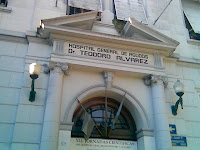
- As Hospital Alvarez is one of the three hospitals that have this program it gets many patients form Buenos Aires province as well.
- The program focuses on “emergency” cases, that is, cases in which the rape occurred within 72 hours of when the victim comes to the program offices
- Hospital Alvarez is the only public hospital in Argentina that investigates violence in its patients’ lives and incorporates the data into its clinical histories.
- Galimberti has a theory: " violence against women has to be a priority for health professionals"

The program focuses in cases where rape happened the 72 hours of when the victim comes to the offices. In cases where women come looking for help more than 72 hours after they got raped, they get referred to specialized centers.
My personal opinion about this topic is that other hospitals should follow the example of Hospital Alvarez and create programs to help rape victims. Though I think that what is more important is that government should do something to prevent rape cases and to make sure guilty man get sentenced into prison.
martes, 19 de junio de 2007
Erasing Tattoos, Out of Regret or for a New Canvas
Canvas: A piece of such fabric on which a painting, especially an oil painting, is executed.
Fence-sitter: One who takes a position of neutrality or indecision, as in a controversial matter.
Pristine: remaining in a pure state
Wedding Gown: wedding dress
Wobbly: unsteady
Sprawl: To spread out in a straggling or disordered fashion
Personal Reaction
Laser tattoo removal has emerged as a solution. The process consists on a series of laser shots to break down tattoo pigments. Each session must be one month away from each other and the whole process might take several months. One special laser is used for each col
 our. It is a very costly, time consuming and painful technique but many people just do it in order to clean up the skin to get a new one. Different procedures are being investigated in order to make things easier. Dermatologist say that nurses are able to do the removal but they think it is better to turn to someone specialized that has studied what to do in the case of an allergic reaction or different mishaps.
martes, 12 de junio de 2007
How "THE" experience got started
Once I got into high school I realized my time was coming and I knew I had to start looking for more information on exchange programs. That is how I came across the Rotary Club. I had to fill a lot of forms and to go through a selection camp. After that they told me I was going to go to New Hampshire, a really small northeastern state in the US.
I got extremely excited and I started preparing everything. I bought winter clothes, bags and all the stuff I needed.
Then finally that day came. It was the 21 August of 2002, I arrived at the airport and surprinsingly most of my closest friend were there to say goodbye to me. That moment really meant something to me. Even though I cried a bit as soon as I got into the plane my emotions were different. I was no longer sad I was just anxious. I just wanted to get to destination and start the experience.
After fourteen hours I got to Boston where my First Host Family was waiting for me. As soon as I saw them I could see how nice they were. We started talking and had no difficulties in communicating during the two-hour car ride to Hancock, the little 9000-resident town where I would stay. They showed me everything they could and introduced me to quiet a lot of people.
As soon as we got into their house It felt warm and comfortable. I met their son and their daughter and we inmediately created a bond.
Once weekend came we took a short ride to Steve´s house. Steve Goldstein was the district counselor and he was in charge of all the exchange students in the area. He organized a barbecue so that we could meet to each other -the exchange students-. It was amazing to get the opportunity to have a conversation with people from all over the world. Then I realized I had taken a great decision.
About one hour after I got to Steve´s house Dieter, the guy from Germany, arrived. We started chatting and instantly clicked. Then the same happened with Conrado, the spanish boy and with Ali, the indian Guy. Out of the 27 exchange students we were, I knew they were going to become my best friends. And with the girls something similar happened with Dominique from Switzerland, Adelina from La Plata, Natalia from Chile and Gloriana from Costa Rica.
This a small summary about how things got started once my childhood dream became real and how my first days were once I got in the States.
Me by Me
domingo, 10 de junio de 2007
THE OTHER MACHU PICHU
Vocabulary
- Alpenglow:A rosy glow that suffuses snow-covered mountain peaks at dawn or dusk on a clear day
- Sashay: To strut or flounce in a showy manner
- Pinwheel: a child's toy consisting of a wheel or leaflike curls of paper or plastic loosely attached by a pin to a stick, designed to revolve when blown by or as by the wind.
- Fuse: A cord of readily combustible material that is lighted at one end to carry a flame along its length to detonate an explosive at the other end.
- Shriek: to utter loud, high-pitched sounds in laughing
Report
Choquequirao, a city in Peru, has a lot of similarities with Mahcu Pichu. It is hardest to reach it and it is not very well known. It may be what Machu Pichu looked like before tourism inflow.
Originaly it was built by Topa Inca because of the similarities with Machu Pichu and it even had the same significance. The tow cities are boaut the same size and wer used for the same religion, political and agricultural functions. Excavation showed the city but a long time passed trough before Peruvian government started witrh the first restoration.
Choquequirao remains unknown but Peru has the intention of large-turism in this area. In the last years more people have visited the place.
Getting to it is pretty tough. The nearest city is Cachora which has no direct bus service. Once you get there,  the scenary is breathtaking with the alpenglow on mountain Salkatay`s snow-covered summit.
Peruvian government is specially interested in preserving communities like Cachora and the other towns near Choquequirao in order to keep them from becoming a new Aguas Calientes, the closest town to Machu Pichu which has grown and became a tourist city. They do not want communities to loose their identities.
For now Choquequirao still belongs to their residents and keeps on being a place full of tradition and customs.